
|
Gravell Watermark Archive
WORD.033.1 |
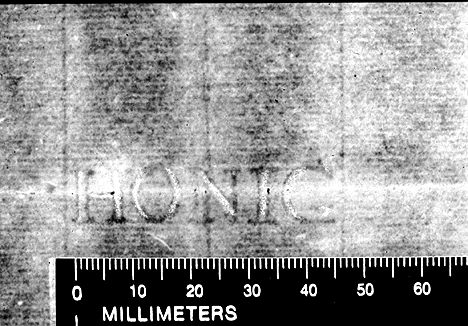 WORD.033.1 REPOSITORY INFORMATION: Folger Shakespeare Library201 East Capitol Street, SE Washington, D. C., United States., DC 20003 phone: (202) 544 4600 |
DATE: 1722 WATERMARK INFORMATION: PRIMARY: NamesWords (IPH KEY: Y) DIMENSIONS: 11 mm high x 45 mm wide SECONDARY: "HONIG" PROCESS: DYLUX PAPER INFORMATION: MANUFACTURE: Laid PAPERMILL: De Vergulde Bijenkopf (The Gilded Beehive) Mill PAPERMAKER: Honig, J. & Zonen LOCATION: Zaan, Netherlands ARTIFACT INFORMATION: ARTIFACT: Blathwayt papers YEAR OF USE: 1722 REPOSITORY: Folger Shakespeare Library SHELFMARK: X.d. 436 (61) DATABASE INFORMATION: RECORD ADDED: 27 December 2000 NO. 1755 GENERAL COMMENTS: One of 62 items from the papers of William Blathwayt. NOTE ON THE PAPER: See Voorn 1960, p. 554, De Vergulde Bijenkopf (The Gilded Beehive) Mill: “This most famous Honig-mill originally was a small oil-mill, named De Kwikstaart (Wagtail), at Wormer. In 1662, the small mill was bought by Cornelis Jans Honigh and equipped for paper making. At the same time, it got its name of Gilded Beehive, as an allusion to the Honig’s family-name (Honig = Honey). In 1668 the mill was moved to Zaandijk and there, in the course of many years, it was changed, enlarged and improved till it was one of the most important paper mills in the country. The sons Cornelis, Jacob and Adriaan Corneliszoon Honigh equipped the mill in 1675 for making writing papers. They also had shares in other paper mills, like De Hobbezak and De Bel. Cornelis Adriaans Honigh, grandson of the founder, managed the mill till 1712; in that year he sold his shares to his cousins Cornelis and Jan Jacobs Honig, owners of the mill De Veenboer. The company of C. & J. Honig became a very important one. Cornelis acquired the Herderskind mill in 1773, the company had an important share in the Herder mill, and in 1738 Jan Honig bought the Eendracht mill. In 1738 the brothers separated, Cornelis taking over the management of the Veenboer and Herdeskind mills, Jan Honig keeping the Bijenkorf and Eendracht mills. “Jan Jacobs Honig died in 1757 and was succeeded by his son Jacob Jans Honig who, in 1774, sold the Eendracht mill and acquired in its place the Wever mill. The company of Jacob Honig & Zonen, always under the management of succeeding sons, had a long life. The Beehive mill was at last sold, in 1854, to Gerbrand de Jong, paper maker with the Schoolmeester and Kaarsemaker mills. The mill was burnt down in 1902.” REFERENCES: Voorn, Henk. De papiermolens in de provincie Noord-Holland. Haarlem: Papierwereld, 1960. |