
|
Gravell Watermark Archive
WORD.085.1 |
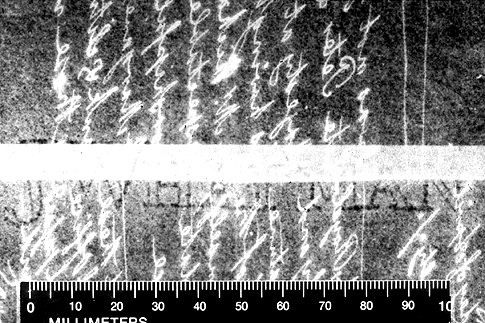 WORD.085.1 REPOSITORY INFORMATION: Library of Congress101 Independence Ave, SE Washington, D. C., United States, 20540 phone: (202) 707-5000 |
DATE: May 4, 1790 WATERMARK INFORMATION: PRIMARY: NamesWords (IPH KEY: Y) DIMENSIONS: 19 mm high x 117 mm wide SECONDARY: "J WHATMAN" PROCESS: DYLUX PAPER INFORMATION: MANUFACTURE: Wove PAPERMILL: Turkey Mill PAPERMAKER: Whatman, James LOCATION: Near Maidstone, Kent (River Len), England ARTIFACT INFORMATION: ARTIFACT: Jefferson letter YEAR OF USE: 1790 London, England REPOSITORY: Library of Congress SHELFMARK: Box 20, #9294-9295 50-767, 168 DATABASE INFORMATION: RECORD ADDED: 20 February 2002 NO. 2360 GENERAL COMMENTS: Thomas Jefferson, General Correspondence. Copy NOTE ON THE PAPER: James Whatman (1702-1759) financed Richard Harris’s acquisition of Turkey Mill in 1738. Harris died in 1739 and in 1740, his widow, Ann, and Whatman were married. “The first known Whatman watermark dates from December 1740, in Select Harmony Fourth Collection, a set of six concertos published by John Walsh. From 1747 many state papers were written on Whatman paper, and it was increasingly used in aristocratic households....Whatman was the first paper maker in Europe to make wove (or vellum) paper....In 1796 Whatman’s son told the American paper maker Joshua Gilpin that his father first made wove paper in 1756” (Baker). James and Ann Whatman’s only son, James (1741-1798) acquired Turkey Mill from his mother in 1762. The younger Whatman, inspired by Benjamin Franklin’s exhibition of wove paper (Paris, 1777) “began to develop it again; he told Gilpin that he had brought it into repute in 1778-9. The government first used wove paper for state papers in 1784, at about the time that other English makers began to produce it, and he began to make antiquarian wove paper” (Baker). Whatman’s health deteriorated after a stroke in 1790, precipitating the sale of the business to the Hollingsworths, for £20,000 in 1794. “He lent his manager William Balston £5000, which enabled him to by a partnership in the new firm, but he does not seem to have considered giving any share in the business to his sixteen-year-old son. Whatman allowed the new firm to use the ‘JWhatman’ watermark, and after the Hollingsworths left the firm in 1806, W. and R. Balston, makers of high quality writing and drawing paper, continued to use the Whatman trademark” (Baker). REFERENCES: Baker, Anne Pimlott. “Whatman, James (1702-1759).” Oxford Dictionary of National Biography. Oxford University Press, 2004 [http://www.oxforddnb.com/view/article/40776, accessed 7 Aug 2007]. |